

HyperBDR SAP HANA Hybrid Cloud DR Solution Best Practices
HyperBDR SAP HANA Hybrid Cloud DR Solution Best Practices
This document is based on a real DR drill project for a Latin American telecommunications operator (including financial services) on Huawei Cloud. It is designed for market and partner audiences, highlighting HyperBDR Orchestration capabilities in SAP HANA scenarios: orchestration coordinates the DR takeover process, first calling HANA Replication to recover the database, then calling HyperBDR Boot-in-Cloud to launch the application layer, achieving a hybrid DR solution.
1. Project Overview
1.1 Customer and Scenario
| Dimension | Description |
|---|---|
| Industry / Region | Telecommunications operator (including financial services), Latin America (Honduras / Costa Rica) |
| Business Characteristics | Core businesses include billing and credit, point-of-sale transactions (POS), document management (OnBase), etc., involving financial transactions and customer identity verification |
| Key Systems | SAP (S/4HANA core transactions, CAR customer activity analysis, HPI reporting), POS point-of-sale systems, OnBase document workflows, MongoDB, etc. |
| Business System Scale | 50 hosts, approximately 50+ TB of storage |
| Source Environment | VMware virtualization environment, production environment on-premises |
| DR Target | DR environment on Huawei Cloud; drill validates RPO/RTO, ensuring billing, credit, and other financial businesses can recover in a controlled, timely, and consistent manner during DR switchover without affecting production |
This project is a typical SAP HANA Disaster Recovery (DR) scenario: SAP-centric, with supporting billing, credit, point-of-sale, and other financial business systems, achieving cloud DR through HyperBDR DR and orchestration capabilities. This scenario has extremely high requirements for data consistency and recovery time, making it suitable as a reference case for financial/telecommunications industry SAP DR.
1.2 HyperBDR Core Value in This Project
Orchestration capability is the most prominent point of this document: The takeover process is coordinated by HyperBDR Orchestration—first calling HANA Replication to recover the database, then calling HyperBDR Boot-in-Cloud to launch application layer hosts (including SLT and 50 others), achieving controlled and orderly DR takeover.
Hybrid DR Solution: By orchestrating SAP HANA Replication and HyperBDR, achieving a hybrid DR architecture of "database-level real-time replication + host-level orchestrated recovery", balancing RPO/RTO requirements with cost-effectiveness.
Object Storage Technology: Using object storage (OBS) as an intermediate storage layer, reducing target-side usage costs, and launching complete business systems in the cloud through Boot-in-Cloud, which is HyperBDR's distinctive capability.
Agentless Approach: This project primarily uses VM agentless mode (source is VMware), requiring no agent installation on the source side, reducing deployment complexity and operational burden.
2. Business Challenges and HyperBDR Responses
SAP HANA DR often faces the following challenges, which this project addresses through HyperBDR DR and orchestration capabilities:
| Challenge | Description | HyperBDR Response |
|---|---|---|
| System Complexity | SAP has strong dependencies with SLT, CAR, HPI, and surrounding applications (POS point-of-sale, OnBase documents, MongoDB), requiring coordinated switching; financial businesses have extremely high data consistency requirements; the scale of 50 hosts and 50+ TB storage increases orchestration complexity | HyperBDR's orchestration capability supports 50 hosts through Boot-in-Cloud parallel recovery and dependency management, ensuring billing and credit data consistency during switching through fixed timelines and responsible parties |
| High RPO/RTO Requirements | Financial transactions and analysis such as billing and credit cannot tolerate long interruptions or significant data loss; customer identity verification (e.g., Valkiria ID queries) must be available in real-time | Orchestration-driven takeover: Orchestration first calls HANA Replication to achieve SAP HANA level RPO≈0, RTO<5 min, then calls Boot-in-Cloud to quickly recover application layer VMs, controlling overall RTO within 2 hours |
| Target-side Costs | Traditional DR solutions require large storage resources on the target side, with high costs | Object Storage Technology: HyperBDR uses object storage (OBS) as an intermediate storage layer, reducing target-side usage costs, and launching complete business systems in the cloud through Boot-in-Cloud, which is HyperBDR's distinctive capability |
| Bandwidth and Synchronization | SLT and post-drill resynchronization are constrained by bandwidth, affecting recovery time | HyperBDR supports policy-based synchronization (periodic/policy synchronization), coordinating with HANA Replication bandwidth requirements, prioritizing critical replication links |
| Deployment and Operations Complexity | Traditional DR solutions require agent installation on the source side, increasing deployment and operational burden | Agentless Approach: HyperBDR uses VM agentless mode, requiring no agent installation on the source side, reducing deployment complexity and operational burden |
These challenges are common in most SAP cloud DR scenarios, so the HyperBDR DR and orchestration capabilities demonstrated in this project have reusable best practices value.
3. HyperBDR Solution and Architecture
3.1 Overall Approach: Orchestration-Driven Takeover Process
HyperBDR Orchestration is the core driver of the takeover process, coordinating all recovery actions:
Orchestration first calls HANA Replication: Recover SAP HANA database (on-premises → Huawei Cloud), achieving database-level RPO≈0, RTO<5 min.
Orchestration then calls HyperBDR Boot-in-Cloud: Launch application layer hosts (including SLT and 50 others, approximately 50+ TB storage) with one click, critical applications ready within 9 min–2 h; using object storage (OBS) to reduce target-side costs, agentless mode to reduce deployment complexity.
Orchestration schedules HANA Replication and Boot-in-Cloud in sequence, forming "database-level + host-level" dual protection, balancing performance and cost.
3.2 Architecture Highlights
Production Side (VMware): SAP HANA (S/4, CAR), SLT, POS, OnBase, etc., deployed in customer's on-premises VMware environment.
DR Side (Huawei Cloud):
HANA secondary node (real-time replication through HANA Replication)
Application layer hosts (including SLT and 50 hosts, orchestrated by HyperBDR to call Boot-in-Cloud after HANA recovery)
Storage Layer: Object Storage (OBS) as intermediate storage layer (approximately 50+ TB), reducing target-side usage costs, supporting Boot-in-Cloud to launch complete business systems in the cloud.
Replication Relationships:
HANA Replication (real-time, database-level)
HyperBDR (periodic/policy synchronization, host-level, through OBS)
The following diagram shows the high-level architecture of this project, demonstrating the HyperBDR orchestration-driven takeover (first HANA Replication, then Boot-in-Cloud) hybrid DR solution:
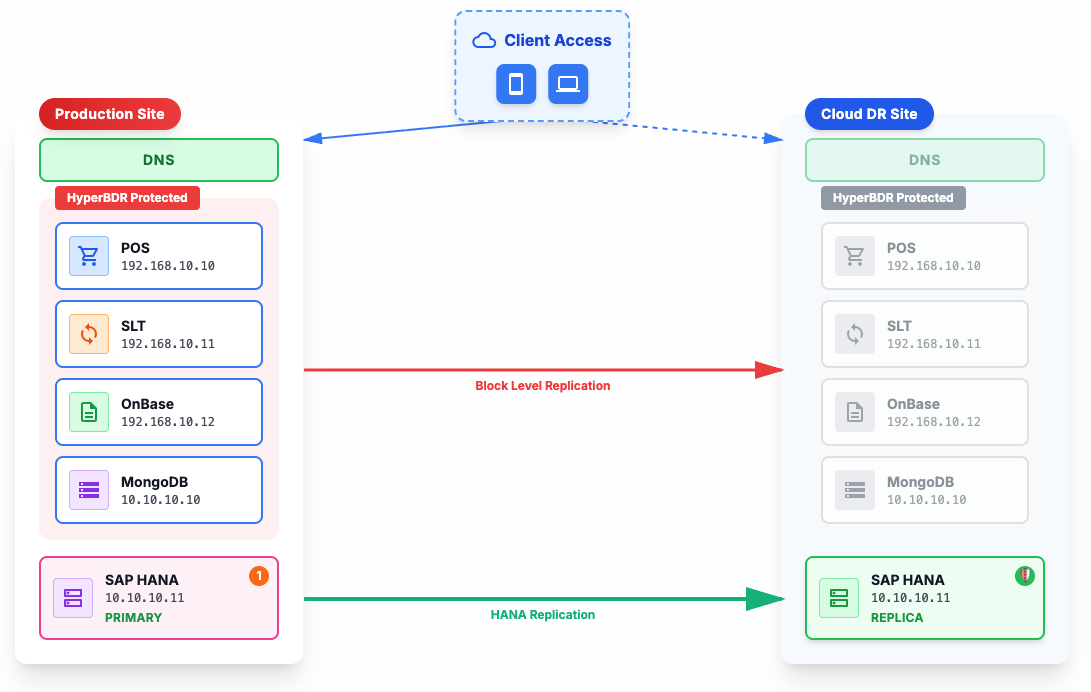
Figure 1 High-Level Architecture: HANA Replication + HyperBDR Hybrid DR Solution
3.3 HyperBDR Core Capabilities Demonstrated in This Project
| HyperBDR Capability | Application in This Project | Value |
|---|---|---|
| Orchestration Capability | Takeover process coordinated by orchestration: first calling HANA Replication to recover database, then calling Boot-in-Cloud to launch 50 application layer hosts, parallel recovery and dependency management, critical applications ready within 9 min–2 h | Most prominent point of this solution: Orchestration as the core driver, achieving controlled and orderly DR takeover |
| Boot-in-Cloud | Using OBS as intermediate storage layer (approximately 50+ TB), reducing target-side usage costs, Boot-in-Cloud launching complete business systems in the cloud | Reducing target-side storage costs, improving DR solution economics; Boot-in-Cloud capability is HyperBDR's core feature |
| Agentless Mode | VM agentless mode, no agent installation required on source side | Reducing deployment complexity and operational burden, improving customer acceptance |
| Policy-based Synchronization | Supports periodic/policy synchronization, coordinating with HANA Replication bandwidth requirements | Flexible response to different RPO/RTO requirements, optimizing bandwidth usage |
4. Implementation Highlights and Drill Best Practices
4.1 Data Replication Phase
During the data replication phase before the drill, this project adopted a hybrid replication strategy:
SAP HANA Database Replication: Real-time database-level replication through SAP HANA Replication, from production SAP HANA to DR SAP HANA, ensuring database-level RPO≈0.
Application Host Replication: Host-level block storage replication through HyperBDR, replicating data from approximately 50 production hosts (including SLT, POS, OnBase, MongoDB, and other application systems) to object storage (OBS), reducing target-side storage costs.
Critical Host Replication Strategy: For approximately 26 critical application hosts (such as SLT, core SAP applications, etc.), using 15-minute replication frequency to ensure smaller RPO for critical business systems and lower data loss risk.
Other Host Replication Strategy: For the remaining approximately 24 hosts, using 3-hour replication frequency, optimizing bandwidth usage and storage costs while ensuring data security.
Data replication is continuous, providing the data foundation for subsequent drills and takeovers. HyperBDR's policy-based synchronization capability supports flexible configuration of replication frequency for different hosts based on business importance, achieving a balance between RPO requirements and cost-effectiveness.
4.2 Drill and Takeover Phase Best Practices
Drills and takeovers are critical stages for validating DR solution effectiveness. This project uses a HyperBDR Orchestration-driven takeover process. The following are detailed steps and best practices during the drill:
4.2.1 Pre-Drill Preparation: Simulating Production Business Synchronization Stop
Before the drill begins, it is necessary to simulate the synchronization cut-off process in a real disaster scenario, ensuring the drill does not affect the production environment. This project's pre-drill preparation includes:
| Step | Time | Key Actions | Purpose |
|---|---|---|---|
| SLT Synchronization Alignment | Approximately 3 hours before drill | HyperBDR SLT automatic/manual synchronization, ensuring data alignment | Complete final data synchronization before cut-off, reducing data loss |
| Stop SLT Replication | Approximately 3 hours before drill | Stop SLT at source (Tigo), controlled stop of replication | Simulate production environment stop, align CAR synchronization before cut-off |
| Stop HyperBDR Synchronization | Approximately 2.5 hours before drill | Stop synchronization of all VMs in HyperBDR (approximately 50 hosts) | Simulate synchronization cut-off, reduce bandwidth requirements; this is the standard process during real takeover (complete cut-off) |
| Stop Secondary Instance Communication | Approximately 15 minutes before drill | Stop secondary SAP HANA instance communication, maintain DR isolation | Ensure DR environment isolation from production environment, HyperBDR agents maintain communication but are inactive |
Key Points of Pre-Drill Preparation:
Pre-drill preparation steps are only executed before test scenarios (drills), and may differ in real takeovers
Controlled synchronization stop ensures data integrity, avoiding continued production data changes during the drill
Simulating cut-off validates DR solution effectiveness in real disaster scenarios
4.2.2 Drill and Takeover Phase
| Phase | Objective | Detailed Steps and HyperBDR Key Actions | Time and Results |
|---|---|---|---|
| Phase 1: Takeover Start | Database recovery | 1. Orchestration first calls HANA Replication to take over SAP HANA database - CAR database takeover: 20 seconds - Modify hosts file: 6 minutes - S4 database takeover: 1 minute 20 seconds 2. Start SLT on Huawei Cloud: 48 minutes 3. Verify database connections and status | • SAP HANA total takeover time: < 5 minutes • SAP HANA ready: within approximately 5 minutes after takeover • SLT ready: 48 minutes |
| Phase 2: Infrastructure Launch | Applications and dependencies ready | 1. Orchestration then calls Boot-in-Cloud to launch application layer hosts 2. Create instances through HyperBDR: approximately 30 VMs created during drill (50 hosts total protected) - Creation time: 9 minutes to 2 hours 3 minutes - Critical applications: POS, SAP HPI 3. Initial configuration and hosts file adjustment: 20 minutes 4. Initial application function verification: progressive testing as VMs become available | • Critical application creation time: 9 minutes to 2 hours 3 minutes • POS infrastructure: < 2 hours 30 minutes • OnBase infrastructure: approximately 3 hours 40 minutes |
| Phase 3: DR Operation Verification | Business and stability verification | 1. Verify VM functions recovered through Boot-in-Cloud 2. Test application layer functions (POS, OnBase, MongoDB, etc.) 3. SAP Router (EIP) test: successful cloud access verification 4. Verify business continuity (billing, credit, and other financial businesses) 5. Monitor system stability and performance | • Application servers running stably, response times within normal expected range • Active Directory successfully verified and accessible on Huawei Cloud • POS MongoDB: some nodes ready |
| Phase 4: Wrap-up and Resynchronization | Restore production replication, no residual impact | 1. Stop secondary SAP HANA, begin configuration for fast resynchronization 2. DR VM shutdown and deletion: controlled cleanup 3. Restore VPN: successfully restore connectivity 4. HANA Replication resynchronization: - CAR resynchronization: approximately 12 hours - S4 resynchronization: approximately 12 hours (after bandwidth optimization) 5. HyperBDR replication recovery, re-establish host-level replication 6. Bandwidth optimization: increase from 200 Mbps to 400 Mbps | • CAR resynchronization: approximately 12 hours • S4 resynchronization (before optimization): over 48 hours (failed due to bandwidth limitations) • S4 resynchronization (after optimization): approximately 12 hours • Post-drill recovery time (after optimization): < 19 hours |
HyperBDR Best Practice Points During Drill:
Orchestration-driven takeover: HyperBDR Orchestration coordinates the entire takeover process—first calling HANA Replication to recover database, then calling Boot-in-Cloud to launch application layer hosts. Orchestration ensures correct recovery order, preventing applications from starting before the database is ready, avoiding connection failures.
Parallel Recovery and Dependency Management: HyperBDR's orchestration capability supports multiple VMs through Boot-in-Cloud parallel recovery while managing dependencies between applications. Critical applications start first, shortening overall recovery time; 50 hosts can complete recovery within 2 hours.
Boot-in-Cloud: Using OBS as an intermediate storage layer, reducing target-side usage costs, and launching complete business systems (50 hosts, 50+ TB storage) in the cloud through Boot-in-Cloud, which is HyperBDR's core distinctive capability.
Bandwidth and Priority Coordination: During post-drill resynchronization, HyperBDR's policy-based synchronization can coordinate with HANA Replication bandwidth requirements, prioritizing critical replication links. This project optimized bandwidth (200→400 Mbps), reducing post-drill recovery time from approximately 48 hours to <19 hours.
5. Key Results and Metrics
Using HyperBDR orchestration-driven hybrid DR solution, the following results can be achieved during DR drills and takeover processes, demonstrating measurable outcomes of HyperBDR DR and orchestration capabilities in SAP HANA scenarios:
| Metric | Result | HyperBDR Contribution |
|---|---|---|
| SAP HANA Takeover | RTO < 5 minutes, RPO ≈ 0 | HANA Replication (database-level) |
| SAP HANA Ready | Within approximately 5 minutes after takeover | HANA Replication |
| SLT Ready | 48 minutes | HyperBDR Boot-in-Cloud launching SLT |
| Application Layer Ready | Critical application creation time: 9 minutes to 2 hours 3 minutes | HyperBDR Boot-in-Cloud launching application layer hosts (approximately 30 VMs created during drill, 50 hosts total protected) |
| Infrastructure (POS) | < 2 hours 30 minutes | HyperBDR Boot-in-Cloud launching POS-related VMs |
| Infrastructure (OnBase) | Approximately 3 hours 40 minutes | HyperBDR Boot-in-Cloud launching OnBase VMs |
| Post-Drill Recovery Time (Before Optimization) | Approximately 48 hours (bandwidth 200 Mbps) | HyperBDR policy-based synchronization + HANA Replication coordination |
| Post-Drill Recovery Time (After Optimization) | < 19 hours (after bandwidth optimization to 400 Mbps) | HyperBDR policy-based synchronization + HANA Replication coordination |
Note: Values may vary under different environments and bandwidth conditions, but the HyperBDR orchestration-driven hybrid DR architecture is replicable.
6. Project Summary
This project successfully validated the effectiveness of HyperBDR DR and orchestration capabilities in SAP HANA scenarios, achieving a cloud DR solution for a Latin American telecommunications operator (including financial services). Key project achievements are as follows:
6.1 Key Achievements
SAP HANA Database Takeover: RTO < 5 minutes, RPO ≈ 0, achieving database-level real-time replication through HANA Replication
Rapid Application Layer Recovery: 50 hosts launched through HyperBDR Boot-in-Cloud, critical applications ready within 9 minutes to 2 hours 3 minutes
Hybrid DR Architecture Validation: Successfully validated hybrid DR solution of "database-level real-time replication + host-level orchestrated recovery", with orchestration coordinating the entire takeover process
Cost Optimization: Reduced target-side storage costs through object storage (OBS) technology, with 50+ TB storage using object storage solution, significantly improving DR solution economics
Agentless Deployment: Using VM agentless mode (source is VMware), reducing deployment complexity and operational burden
6.2 Project Value
This project demonstrates the core value of HyperBDR Orchestration capabilities in complex SAP HANA DR scenarios:
Orchestration-driven Takeover: HyperBDR Orchestration coordinates DR takeover process, first calling HANA Replication to recover database, then calling Boot-in-Cloud to launch application layer hosts, achieving controlled and orderly takeover, with overall RTO controlled within 2 hours
Hybrid DR Solution: By orchestrating SAP HANA Replication and HyperBDR, achieving hybrid DR architecture of "database-level real-time replication + host-level orchestrated recovery", balancing RPO/RTO requirements with cost-effectiveness
Boot-in-Cloud: Using OBS as intermediate storage layer, reducing target-side usage costs, and launching complete business systems (50 hosts, 50+ TB storage) in the cloud through Boot-in-Cloud, which is HyperBDR's core distinctive capability
Policy-based Synchronization: Supports flexible configuration of replication frequency based on business importance (critical hosts 15 minutes, other hosts 3 hours), achieving balance between RPO requirements and cost-effectiveness
6.3 Typical Scenario
This project covers a typical combination of SAP S/4HANA + CAR + HPI + surrounding applications (POS, OnBase, MongoDB), particularly the DR scenario of "billing and credit + SAP core systems" in the financial/telecommunications industry. The project validated HyperBDR's DR capabilities at a scale of 50 hosts and 50+ TB storage, providing representative and reference value for similar customers.